
Guides
5 things nobody tells you about meal prep products
Five things about meal prep products that rarely make the sales page, from portion creep to the cost of a cold chain that never stops running.
What to take away
- Meal prep products are a format decision firstsingle meal, multi-day box, family tray, or bulk protein. The format sets your packaging, cold chain, and price floor.
- Protein is the cost driver. Track cost per gram of protein per portion, not cost per ingredient, or a cheap cut can still sink a box.
- The cold chain is a subscription cost, not a delivery cost. Insulation, gel packs, and box size repeat every week for every customer.
- Allergen and labeling rules follow the food, not the business model. Confirm with your state retail food code and your local health department.
- Churn shows up in week three. A customer who skips one week is more likely to cancel than a customer who never skipped.
- Five tools carry most of thisthe Escali Primo portion scale, Uline gel ice packs, DayMark MoveMark dissolvable labels, the ThermoWorks Thermapen ONE, and ReCharge for skip tracking.
This article covers general prepared-meal business operations. It is not food-safety, allergen, nutrition, or labeling advice. Requirements vary by ingredient, process, packaging, and jurisdiction. Confirm controls with your state retail food code, your local health department, and a qualified food safety professional.
What a meal prep product actually is
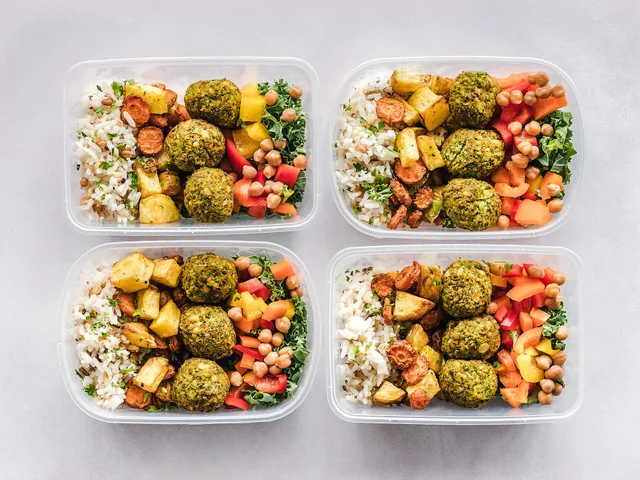
A meal prep product is a packaged, portioned, ready-to-eat or reheat meal sold on a repeating schedule. That sounds simple until you pick a format, because the format decides everything downstream: packaging, cold chain, label, and break-even.
Four Meal Prep Formats Compared
Single meal
- Unit cost
- Lowest
- Packaging cost
- Highest per calorie
- Cold chain
- Light
- Portion control
- Easy
- Perceived value
- Clear
Multi-day box
- Unit cost
- Low
- Packaging cost
- Heavy cold chain
- Cold chain
- Heaviest
- Portion control
- Easy
- Perceived value
- Best retention
Family tray
- Unit cost
- Low per serving
- Packaging cost
- Lowest labor
- Cold chain
- Moderate
- Portion control
- Hardest
- Perceived value
- Family sized
Bulk protein
- Unit cost
- Highest margin
- Packaging cost
- None
- Cold chain
- Moderate
- Portion control
- By weight
- Perceived value
- Weakest
- Single meal.One portion, one container, one label. Lowest unit cost, highest packaging cost per calorie. CookUnity sells chef-made single meals this way, typically $11 to $14 each depending on plan size.
- Multi-day box.Five to seven single meals shipped together. Best retention, heaviest cold chain. Factor's plans run from 6 to 18 meals a week.
- Family tray.One large format meal for four to six servings. Lowest labor per serving, hardest to portion consistently.
- Bulk protein.Cooked protein sold by weight, no sides. Highest margin, weakest perceived value.
Each format carries a different cold-chain requirement, a different label, and a different break-even. Pick one before you write a menu.
Thing one: portion creep, and the Escali Primo scale that catches it
Nobody tells you that your portions drift. A prep cook filling trays by eye adds two ounces over spec, and two ounces across 400 meals is 50 pounds of protein a week.
Weigh the first ten portions of every batch. If the average is over spec, the batch is over spec. This is a training problem, not a discipline problem, and it resets every time you hire.
A portion scale such as the Escali Primo, typically $25 to $30, reads to 0.1 ounces and takes the eye out of the job. Souper Cubes trays, typically $20 to $40, freeze sauce or cooked protein in marked 1-cup and 2-cup blocks, so a batch is standardized before it reaches the line.
The arithmetic is simple. Multiply your overage in ounces by portions per week, then by your cost per ounce. That number is your monthly portion creep. It never appears on a P&L line because it hides inside food cost.
Thing two: the cold chain is a subscription, and Uline gel packs bill you weekly
Most operators price delivery once and forget it. Insulation, gel packs, and box size repeat every single week for every single customer, whether they order or not.
Uline sells gel ice packs by the case, typically $1 to $2 each, and insulated box liners that add a few dollars to every shipper. Sonoco ThermoSafe makes temperature-controlled packaging for the same job, sold to businesses in case quantities.
A box that holds five meals needs more insulation than a box that holds two. If you upsell a customer from three meals to five, your packaging cost rises with the order, and your delivery cost does not fall.
Track packaging cost per box separately from delivery cost per stop. When you know both, you can see which customers are actually profitable, and it is rarely the ones ordering the most food.
Thing three: allergen and label rules follow the food, whatever printer you use
A meal prep product is a packaged food. The label rules that apply to a grocery item generally apply to you, and they follow the food, not your business model.
The FDA publishes a state-by-state directory of retail food agencies and codes, which is the right starting point for finding your regulator: State Retail and Food Service Codes and Regulations by State. Your state retail food code and county health department set the specifics.
Two things operators get wrong. First, they assume a subscription model is exempt because the customer ordered in advance. Second, they assume a cottage food exemption covers cooked, refrigerated meals. Both assumptions are jurisdiction-specific and both need a call to your local health department before you sell.
Daily date coding is where the rule bites. DayMark MoveMark dissolvable labels, 1 inch rounds, 500 per roll, typically $20 to $25, wash off in the dishwasher so containers come back clean. A Brother QL-800, typically $80 to $100, prints date and allergen text on continuous thermal tape with no ink.
If you make any health or nutrition claim on the label or the sales page, the FTC's advertising guidance applies: Advertising FAQs: A Guide for Small Business. Claims must be truthful and supported.
Thing four: your team is a food service team, not a packing team
Four Roles in a Prep Kitchen
- Chef or kitchen lead owns recipes and cook schedule
- Prep cooks portion and cook
- Packers seal, label, and stage
- Food safety lead owns temps, logs, allergens
A food safety lead owns temperatures, logs, and allergen controls. That job needs a ThermoWorks Thermapen ONE, about $115, which reads in one second to within half a degree, and Cambro Camwear 2-quart rounds, typically $8 to $14 with lids, that stack on the line.
The Bureau of Labor Statistics describes food service managers as responsible for staff, supplies, and food preparation. They also handle sanitation and daily operations, often on nights, weekends, and holidays: Food Service Managers.
A subscription kitchen runs on the same schedule, because customers expect Monday delivery. That schedule is the thing nobody warns you about. Your busiest production days are Sunday and Monday, so your staffing model looks nothing like a restaurant's.
Thing five: churn hides in the skip button
A customer who skips a week feels like a save. It usually is not. Skipping is the first step in a cancellation sequence, and by the time the cancel arrives, you have lost the habit.
Watch two numbers weekly: skip rate and third-order retention. If skip rate rises before retention falls, you have a menu problem. If retention falls first, you have a product or delivery problem.
The fix is rarely a discount. It is usually a menu rotation that gives the customer a reason to come back, or a delivery window that actually fits their week.
Both numbers live in your subscription software. ReCharge, typically around $99 a month on its standard plan, logs every skip and pause, and the Shopify Basic storefront underneath it runs $39 a month.
Keep records that let you see this pattern. The IRS guidance on recordkeeping is a reasonable baseline for what to retain and for how long: What kind of records should I keep?.
A worked example: how the five things hit one five-meal box
Say a kitchen sells a five-meal box at a set weekly price. Portion creep adds two ounces of protein per meal, or ten extra ounces a box, every box, every week.
The cold chain adds a fixed packaging cost per box that does not shrink when the customer orders fewer meals. The label carries an allergen statement that has to be right for every ingredient in every recipe.
The team works Sunday to hit Monday delivery. A customer who skips week two is already halfway out.
None of these five things appear on a sales page. All five decide whether the box makes money.
Common questions
Why is portion creep worse for meal prep than for a restaurant?
A restaurant cooks to order, so an over-portion is one plate. A meal prep kitchen cooks to batch, so an over-portion repeats across every container in the run. The error scales with volume instead of staying flat.
Does a subscription model change which food rules apply?
No. The rules follow the food and how it is packaged, stored, and delivered, not how the customer paid. Confirm with your state retail food code and your local health department before you sell.
How do I price a box when packaging cost changes with size?
Price the format, not the meal. Set a price for the five-meal box and a separate price for the three-meal box, then check that each covers its own packaging and delivery cost.
If the smaller box cannot cover its cold chain, do not sell it. For a market anchor, plan-based services such as Factor and CookUnity typically list $11 to $14 per meal on larger plans, and more per meal on smaller ones.
What should I track in the first month?
Track four numbers weekly: food cost percentage, packaging cost per box, skip rate, and third-order retention. If you can only track one, track third-order retention, because it tells you whether the product is worth repeating.
What are the five products worth buying first?
Five items cover most of what a sales page leaves out. The Escali Primo portion scale, typically $25 to $30, catches portion creep. Uline gel ice packs, typically $1 to $2 each in case quantities, hold the cold chain. DayMark MoveMark dissolvable labels, typically $20 to $25 per roll of 500, keep date codes honest.
The ThermoWorks Thermapen ONE, about $115, gives a one-second read on cook temperatures. ReCharge, typically around $99 a month, shows you the skips before the cancels arrive.
When you are ready to seal and label, the packaging choices that hold up under a weekly cold chain are covered in how to package meal prep products for customers.