Guides
Meal prep companies: what to keep and what to drop
Twenty-five meal prep companies, judged on what an operator can copy: production model, delivery radius, packaging, menu discipline, and unit economics.
What to take away
- Read each company below for one transferable decisioncommissary or shared kitchen, delivery radius, packaging format, menu rotation, and how it prices a week.
- A competitor's public menu tells you its SKU count and rotation speed. Its packaging tells you its cold chain. Its delivery map tells you its radius. None of that is confidential.
- Copy the model, never the numbers. Your rent, wage, food cost, and churn come from your own books.
- Confirm licensing, labeling, and food safety requirements with your state and county health department, the FDA Food Code, and a qualified food safety professional.
This article covers prepared-meal business operations. It is not food safety, nutrition, allergen, or labeling advice. It is not licensing, employment, tax, insurance, or legal advice. Those requirements vary by ingredient, process, packaging, and jurisdiction, so confirm them with your state and county health department and a licensed professional.
How to read a competitor in ten minutes
Order a week. Photograph the box, the seal, the label, and the ice pack. Weigh the portions. Count the SKUs. Note the rotation date printed on each tray.
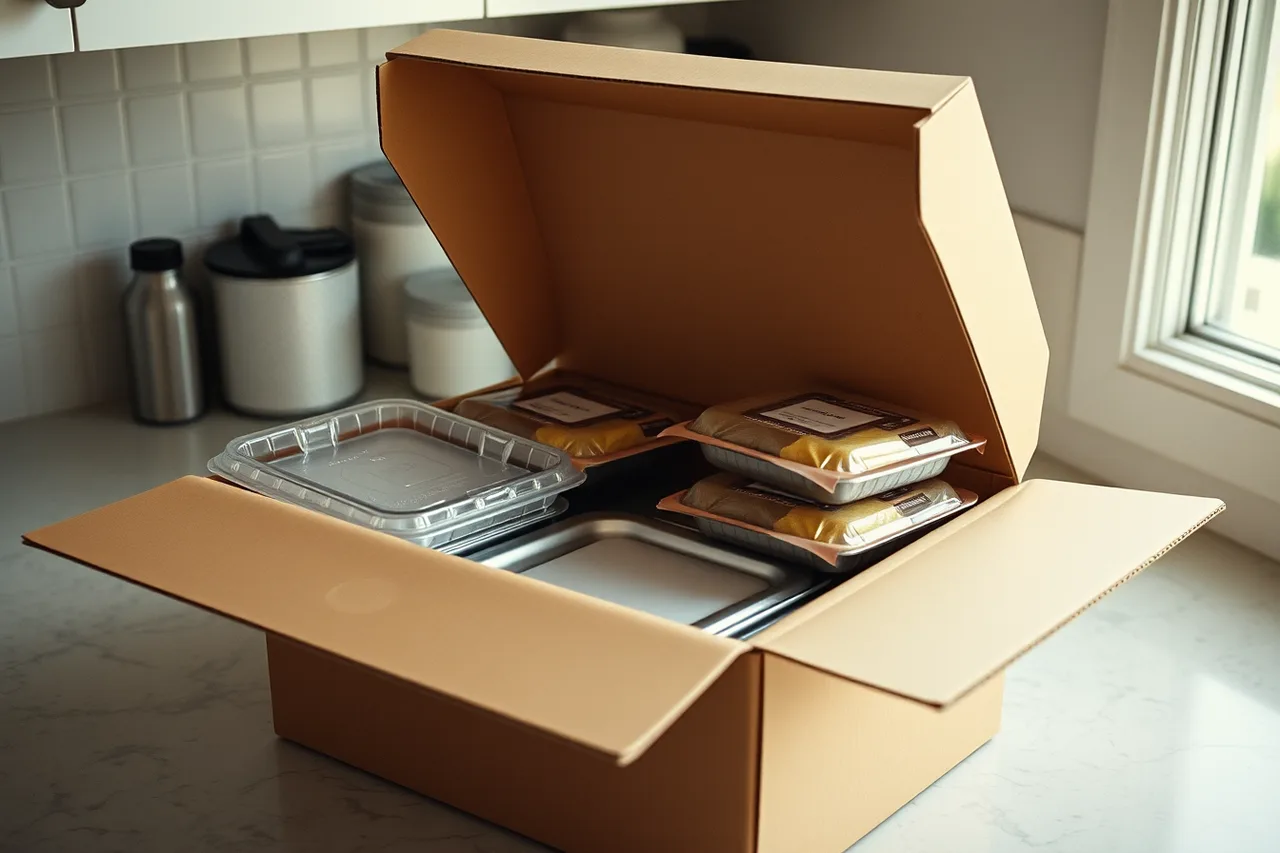
That single order gives you the delivery radius from the shipping label, the packaging cost from the box itself, and the menu discipline from how many dishes repeat. It costs one week of a subscription.
Then ask what the company chose to be good at. Fresh N Lean runs lean, high-volume production with a rotating menu. CookUnity works with individual chefs and pays them per dish. Trifecta built its brand on macro tracking. Those are three different cost structures, and copying the wrong one for your kitchen is how a subscription box loses money.
The 25 companies, and what each one teaches
The 25 companies
| Company | Model to study | What it tells you |
|---|---|---|
| Fresh N Lean | High-volume commissary, rotating menu | How to hold quality at scale |
| CookUnity | Chef marketplace, per-dish payouts | Variable labor cost per SKU |
| Trifecta Nutrition | Macro-tracked meals | Labeling drives the whole menu |
| Territory Foods | Local kitchen network | Radius without a national plant |
| Snap Kitchen | Retail plus subscription | Two channels, one kitchen |
| Freshly | National DTC at scale | What volume does to packaging cost |
| Tempo by Home Chef | Bundled with meal kits | Cross-selling two formats |
| Sunbasket | Organic sourcing story | Ingredient cost as positioning |
| Daily Harvest | Frozen, plant-forward | Freezer space replaces shelf life |
| Thistle | Plant-forward, regional | Narrow menu, deep repeat |
| Mosaic Foods | Frozen vegetarian | Low waste, long hold time |
| Splendid Spoon | Smoothies and bowls | Non-entree SKUs, same box |
| Sakara Life | Premium wellness | Price ceiling in a crowded market |
| Pete's Real Food | Paleo, single kitchen | Small menu, high compliance |
| ICON Meals | Athlete and fitness focus | Portion size as the product |
| Eat Clean Bro | Regional delivery, high frequency | Route density beats radius |
| MealPro | Build-your-own meals | Configurable SKUs, harder prep |
| Fresh Meal Plan | Family-size portions | Larger pack, lower unit cost |
| Nourish Meals | Local, subscription-first | Small radius, tight prep schedule |
| Veestro | Fully plant-based, frozen | One protein source, simpler purchasing |
| BistroMD | Physician-designed positioning | Claims need substantiation |
| Diet-to-Go | Portion-controlled, retail pickup | Pickup points cut delivery cost |
| FlexPro Meals | Frozen, high-protein | Freezing changes your prep day |
| Methodology | Premium, branded packaging | Packaging as the visible product |
| Factor | Scale plus diet variety | Menu breadth at volume |
Treat this as a reading list, not a ranking. Verify each company's current ownership, kitchens, service area, and published policies before you cite it.
What to copy, and what to leave
Copy the delivery radius. If a company ships two-day ground from one plant, its packaging and ice pack are doing work your local van does not need to do.
Copy the SKU count. A menu of twelve dishes cooked weekly beats a menu of forty cooked badly, and it cuts your purchasing to fewer suppliers.
Leave the pricing. A competitor's price reflects its rent, its labor market, and its volume. Build yours from your own food cost, packaging, labor, and delivery cost per box, then set the margin you need to cover fixed costs.
Leave the claims. "Physician-designed" and similar positioning carry substantiation duties. Check any label or health claim against FDA and USDA labeling rules and your state health department before it goes on a box.
Checks to make before committing
U.S. Small Business Administration: SBA Business Guide organizes ownership into planning, launch, management, and growth. It covers these topics:
- market research
- startup costs
- permits
- insurance
- hiring
U.S. Bureau of Labor Statistics: Food Service Managers describes the role as:
- staff
- supplies
- food preparation
- sanitation
- budgets
- payroll records
Managers often work nights, weekends, and holidays.
U.S. Food and Drug Administration: State Retail and Food Service Codes and Regulations lists the retail-food agency and code for each state, which is why your exact location and operating model decide your rules.
Common questions
Should I copy a competitor's menu exactly?
No. Copy the structure: how many dishes, how often they rotate, and which ones repeat. Your suppliers, kitchen capacity, and customer base set the actual list.
How many companies should I study before launching?
Five is enough to see the range of models. One national operator, one regional, one local, one frozen, and one premium will cover the cost structures you might choose.
Can I use a competitor's price as my starting point?
Only as a ceiling check. Build your price from your own food cost, packaging, labor, and delivery cost per box, then compare. Their rent and volume are not yours.