
Guides
US Meal Prep Subscriptions: Lessons from Canada
Meal prep subscriptions in the US can borrow Canadian approaches to labeling, packaging, pricing and retention, then test them against local costs and rules.
What to take away
- Canada runs one federal labeling framework under Health Canada and the CFIA; the US splits the same job across FDA, USDA FSIS, state agriculture departments and county health departments.
- Bilingual labels are mandatory in Canada. In the US, English is the only required language, so Spanish is a market decision, not a compliance one.
- For meal prep subscriptions, all-in weekly pricing and a skip-week option are the two Canadian habits most worth testing, because both attack churn directly.
- FTC rules on auto-renewal, cancellation and advertising claims apply to every US subscription box, whatever a Canadian competitor does.
- Test one change at a time on 20 to 50 subscribers for two to four weeks, and measure revenue per subscriber rather than sticker price.
How US and Canadian meal prep subscription rules diverge
A US meal prep subscription answers to more than one regulator. The FDA food labeling rules govern nutrition facts, ingredient lists and allergen statements on packaged food sold to subscribers. The FDA Food Code and your county health department cover how the food is stored, cooked and cooled.
US vs Canada meal prep rules
United States
- Labeling authority
- FDA
- Label languages
- English
- Meat oversight
- USDA FSIS
- Subscription disclosure
- FTC guidance
- Home production
- State cottage laws
Canada
- Labeling authority
- Health Canada
- Label languages
- English and French
- Meat oversight
- CFIA
- Subscription disclosure
- Provincial law
- Home production
- Provincial rules
Cottage food laws are set state by state, and most subscription meal prep outgrows them. California's Homemade Food Act and the Texas cottage food law both cap what a home kitchen can sell and where it can sell it. Meat and poultry add USDA FSIS oversight on top.
Canada centralizes the same work. Health Canada writes the food safety and labeling standards under the Food and Drugs Act, and the Canadian Food Inspection Agency enforces them. Provincial health authorities issue permits, but the label rules do not change at the border.
United States
- Core labeling authority
- FDA
- Required label languages
- English
- Meat and poultry oversight
- USDA FSIS
- Subscription disclosure
- FTC guidance
- Home production
- State cottage food laws
Canada
- Core labeling authority
- Health Canada
- Required label languages
- English and French
- Meat and poultry oversight
- CFIA
- Subscription disclosure
- Provincial consumer protection law
- Home production
- Provincial rules
The practical consequence is tracking. A US operator maintains a compliance calendar with federal, state and county entries. That work is also a selling point: a subscriber who sees a current health permit and a complete allergen statement has one less reason to cancel.
Subscription terms diverge the same way. The FTC business guidance on negative option marketing covers auto-renewal, free-trial conversion and cancellation for meal prep services. Canada leaves renewal consent to provincial consumer protection law, so a Toronto competitor's signup flow is not a template.
The FTC's competition and consumer protection guidance sets out what a subscription seller may claim about savings, results and endorsements. Read it before you write a single line of ad copy.
Demand data is where the two markets part company. The BLS Consumer Expenditure Survey tracks household food spending, including food away from home, and it is the closest public proxy for subscription demand. Canadian spending patterns sit under different taxes and currency, so a converted price tells you nothing about what a US household will pay.
Track your own version of that demand weekly. The meal prep KPIs owners should track monthly cover churn, order volume and food cost percentage, and they will tell you faster than any survey whether a price change landed.
Packaging choices that transfer, and the ones that do not
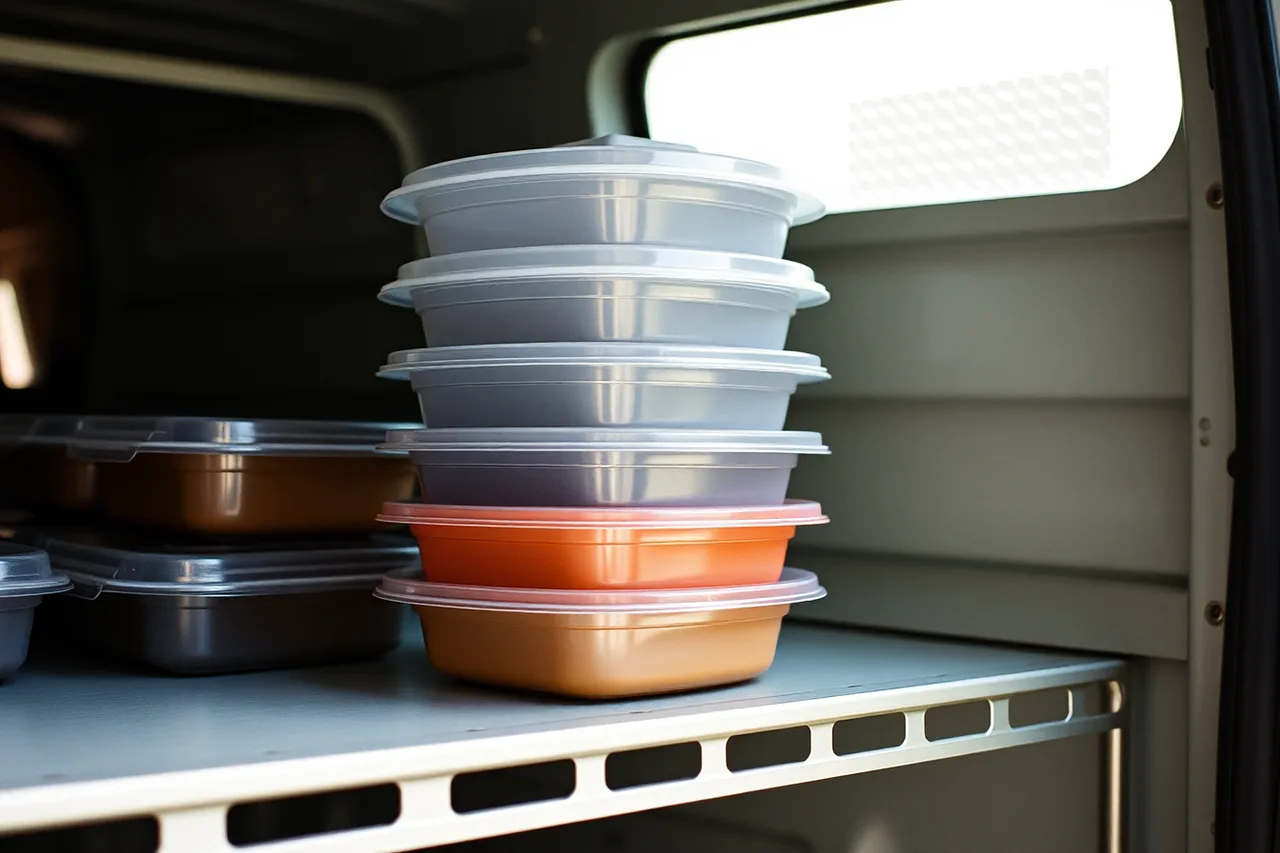
Canadian meal prep packaging leans on four habits: bilingual labels, recyclable or compostable containers, stackable formats sized for apartment refrigerators, and reheating icons that read without words.
Only the first is a legal requirement, and only in Canada. A US label needs English. Adding Spanish widens your market in Phoenix or Miami, but it does not replace the English statements.
Recyclable containers are a local question, not a national one. Curbside programs accept different resins in different cities, and an unqualified recycling claim can draw FTC scrutiny under the Green Guides. Call your hauler and ask what your container actually becomes.
Stackable formats travel well. A container that nests cuts pallet and van space, which shows up directly in your delivery cost per order. Test the stack height against your actual cooler and van shelves before you commit to a mold.
Freezer-to-oven containers exist in both markets, and in the US they must meet FDA food contact substance rules. Ask the supplier for the migration testing documentation rather than assuming a restaurant supply listing covers it.
When you package meal prep products for repeat orders, the failure modes are mundane: a lid that leaks in transit, a film that will not peel, a container that warps in a 425F oven. Each one produces a refund and a cancellation risk.
A worked example. Suppose a container upgrade costs $0.40 more per meal and your average subscriber orders 10 meals a week for 20 weeks. That is $80 in added cost per subscriber.
If the better container cuts weekly cancellations enough to extend the average subscription by four weeks, compare the contribution margin on those four weeks against $80.
Run the arithmetic with your own numbers before ordering a pallet.
Pricing structures and retention lessons
Canadian operators tend to quote one weekly number that already includes delivery, tax and the container. US checkout pages often add delivery, a small-order fee and tax at the last step, which is where carts die.
All-in vs itemized checkout
All-in price
- Delivery
- Included
- Tax
- Included
- Small-order fee
- None
- Cart abandonment
- Lower
- Retention
- Often better
Itemized checkout
- Delivery
- Added at last step
- Tax
- Added at last step
- Small-order fee
- Added at last step
- Cart abandonment
- Higher
- Retention
- Weaker
Test an all-in price against your current structure with new subscribers only. Compare revenue per subscriber, not headline price, because a higher all-in number with no surprise fees often retains better.
Tiered plans are the second transferable habit. Six, twelve and eighteen meals a week suit different household sizes, and the larger tiers carry a per-meal discount that raises average order value. The tiers must still cover your food cost, labor and route.
Menu variety is the third. Boredom cancels more subscriptions than price does. A weekly swap feature with eight to ten choices gives the subscriber control without exploding your prep list.
Communication is the fourth, and it is free. Send a reminder before each renewal with the date, the amount and the cancellation link. The FTC guidance treats buried renewal terms as deceptive, and subscribers who feel trapped cancel harder than subscribers who feel informed.
A pause option beats a cancellation. One skip per quarter, with a reminder email, keeps the account and the payment method active, and most skippers return the following week.
Referrals work in both markets. A free meal for the referrer and the referee is a common Canadian offer, and it is legal in the US if you follow FTC endorsement rules and disclose the material connection.
Price the offer before you launch it. A meal prep quote template with pricing examples forces the referral cost, the packaging and the delivery into the same sheet, which is where you find out whether the free meal is affordable.
Labeling and bilingual packaging for cross-border appeal
A US packaged meal needs nutrition facts, an ingredient list, an allergen statement and net quantity in English. The 21 CFR Part 101 spells out each element, including type size and placement.
Canadian labels carry the same information in English and French. If you sell into Canada, both languages are mandatory. If you sell only in the US, a second language is optional marketing.
Three bilingual habits are worth borrowing. Icons for reheating and the top allergens read across languages. Side-by-side columns keep the two languages from running together. A QR code can carry the full nutrition panel and cut label clutter.
Keep English prominent when you add Spanish. Required information must appear in English regardless of what else is on the label, and a translation must never obscure a mandatory statement.
Plain language helps every customer. Short ingredient names and a clear reheating line reduce both confusion and customer service calls.
Health claims are the trap. Nutrient content claim rules differ between the two countries, so a label that is legal in Ontario may not be legal in Ohio. Have a qualified food safety professional or labeling consultant review claims before you print.
What US operators should not copy
- Bilingual labels as a compliance strategy. English is the requirement here.
- Canadian prices carried over without US wages, delivery costs and taxes.
- Recycling claims that your city's program does not support.
- Canadian subscription law. US renewal rules come from the FTC and state statutes.
- Home-kitchen models that Canadian provinces allow and many US states do not.
- Free delivery copied from a dense city. Toronto delivery density is not Houston delivery density.
- Benefit and labor assumptions from a market with different health insurance costs.
Labor is the largest of these. Benchmark your own wages against BLS occupational data for your metro rather than a competitor's posted pay. Delivery is the second: a route with 40 stops per hour beats a route with 15, and density decides which one you get.
What not to copy from Canada
- Bilingual labels as US compliance strategy
- Canadian prices without US wages and taxes
- Recycling claims your city does not support
- Canadian subscription law instead of FTC rules
- Home-kitchen models many US states bar
- Free delivery from a dense city like Toronto
Currency and border friction are the last. A Canadian operator runs one currency and one national label. A US operator shipping across state lines runs a new set of rules at each border.
If you want to see how operators have scaled across markets, our list of meal prep companies to watch covers the models that survived contact with more than one jurisdiction.
Tests to run before adopting a Canadian tactic
- Name the tactic and the problem it solves.
- Check it against FDA, FTC, USDA FSIS and county health rules.
- Cost it out, including packaging, labor and delivery.
- Pick a test group of 20 to 50 subscribers.
- Run it for two to four weeks.
- Measure retention, satisfaction and cost per order.
- Scale it, change it or drop it.
Test bilingual labels by printing English and Spanish versions for a subset and surveying clarity. If the response is positive and the print cost is small, expand.
Test all-in pricing with new subscribers only, and compare churn and revenue per subscriber against your standard checkout. A higher all-in price with no fees at the end often wins.
Test recyclable packaging after you confirm your hauler accepts the resin. A claim that is true in Vancouver can mislead a customer in Ohio and draw FTC attention.
Check your subscription terms against FTC guidance before any test starts. A test that breaks the renewal rules is not a test, it is a liability.
Capacity decides the rest. Menu swaps, multiple container types and pause requests all consume prep and packing hours. If the kitchen cannot absorb the change, fix that first, then revisit your marketing and look for ways to win more meal prep customers.
Common questions
What is the biggest regulatory difference between US and Canadian meal prep subscriptions?
Canada sets labeling and food safety standards federally through Health Canada and the CFIA. The US splits the same work across FDA, USDA FSIS, state agriculture departments and county health departments, so a US operator tracks more agencies and permits.
Can I use bilingual packaging in the US?
Yes, and it can widen your reach in Spanish-speaking markets. English remains mandatory for every required label element, so the Spanish panel is an addition rather than a substitute.
How does the FTC affect my subscription meal prep business?
The FTC's negative option guidance covers auto-renewal, free-trial conversion and cancellation. Renewal terms must be clear and conspicuous, and cancellation must be as easy as signing up.
Should I offer all-in pricing like Canadian operators?
Test it on new subscribers and compare churn and revenue per subscriber against your current structure. All-in pricing builds trust, but only if the single number still covers food cost, labor, packaging and delivery.