
Guides
Meal prep hiring: roles, selection and onboarding
Meal prep hiring starts with defining kitchen roles, using consistent selection questions, previewing the shift, and staging onboarding by risk.
What to take away
Meal prep hiring works best when each role has a clear scorecard, a consistent selection process, and onboarding staged by risk.
- Write one scorecard per roleprep cook, packer, food-safety lead, buyer, delivery coordinator, customer-service lead.
- Set pay from your own postings and metro wage data, not from a national average pasted into a local offer.
- Give every candidate the same job-related questions, then verify credentials and references lawfully.
- Preview the real shiftcold room, standing hours, 4 a.m. pack-out, holiday volume, weekend routes.
- Stage onboarding so no one touches a regulated task until a named person signs off on it.
This article covers general prepared-meal business operations. It does not cover individualized advice. This includes food-safety, allergen, nutrition, and labeling advice. It also excludes delivery, licensing, employment, and tax advice. It excludes insurance and legal advice.
Requirements depend on your ingredients, process, packaging, facility, and jurisdiction. Confirm controls with your state or county health department. Also confirm with the FDA Food Code your state has adopted. Also confirm with a qualified food safety professional.
Employment questions belong with a licensed employment attorney or your state labor office.
Start with the roles your kitchen actually runs on
A meal prep operation is not a restaurant with the menu removed. It is a production line that ends at someone's front door, and its roles follow that line.
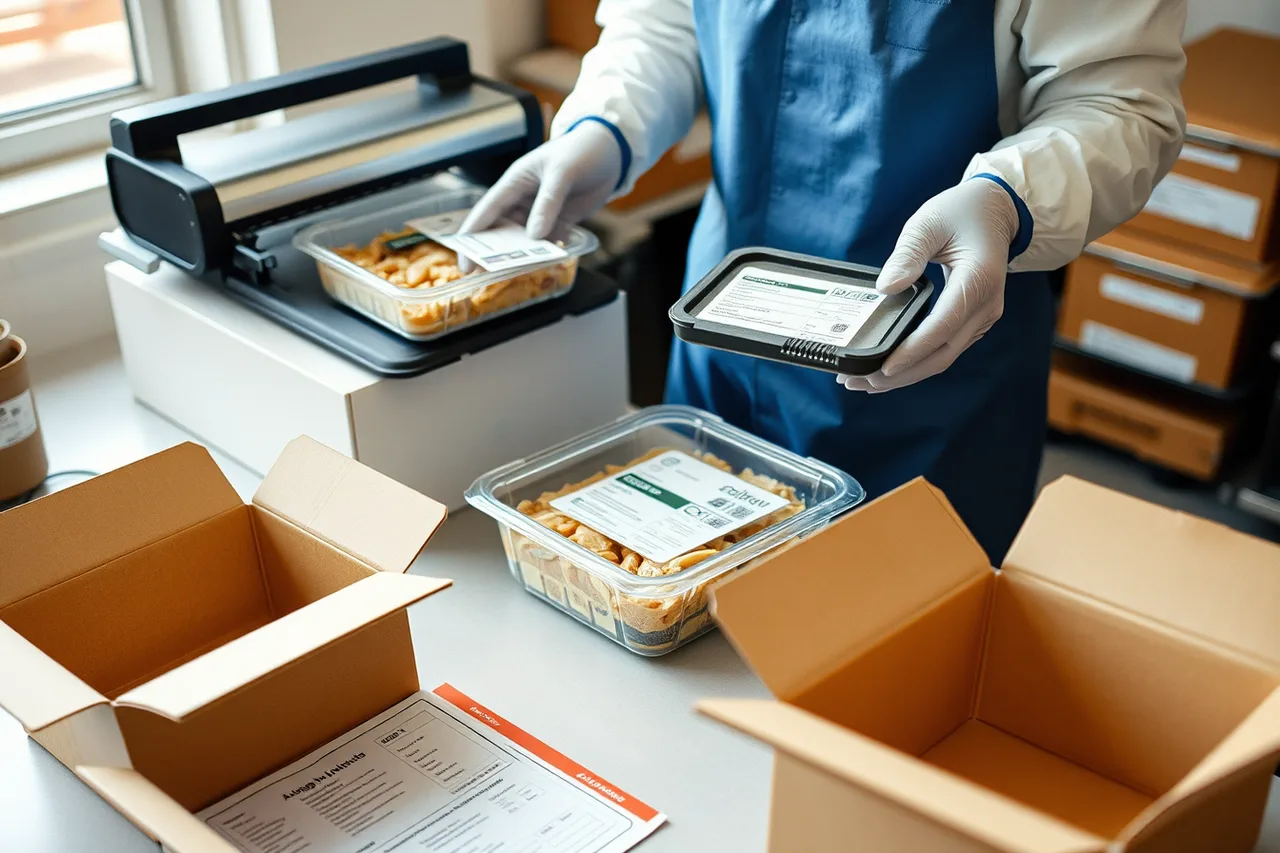

Prep cook. Portions proteins, cooks in batch, cools on sheet pans, labels with date and initials. Owns yield: how many trays a case of chicken actually fills.
Packer. Seals, labels, and builds boxes against the week's order sheet. Owns accuracy: the right meal in the right box with the right allergen label.
Food-safety lead. Runs cooler and freezer logs, calibration, sanitation schedule, and the corrective action when a temperature reads out of range.
Buyer. Sets par levels from the order sheet, negotiates case pricing, and tracks which supplier shorted a line.
Delivery coordinator. Builds routes, packs cold, handles the customer who is not home, and owns the bag-return count.
Customer-service lead. Handles pauses, skips, address changes, and the complaint that a box arrived warm.
One person can hold two of these in a small operation. Write the scorecard anyway, because the scorecard is what you hire against and what you coach from.
Cost the role before you post it
Labor is a line in the box price, not a separate budget. Work the arithmetic in your own numbers:
Cost the role
- Weekly labor cost = (hours per week) x (hourly rate) x (1 + payroll tax and insurance rate).
- Labor per box = weekly labor cost / boxes shipped that week.
- Contribution per box = box price - ingredients - packaging - delivery - labor per box.
If contribution per box is thin, the fix is usually route density or batch size, not a lower wage. Cutting the prep cook's hours to save the line pushes overtime onto the packer and errors onto the customer.
For market context, the U.S. Bureau of Labor Statistics: Food Service Managers reports what food service managers do and how they are paid, including the nights, weekends, and holidays the schedule often carries. Use it as a research starting point. Your metro wage data and your own postings set the offer.
Write the scorecard before the job post
Each scorecard carries six lines. They cover decisions the role makes. They cover tasks done daily. They cover customer contact. They cover records the role signs. They cover equipment it operates. They cover the first-six-month outcome.
For a packer, that reads: decides nothing about menu, decides box sequence.
Tasks are seal, label, pack, stage.
Customer contact is zero.
Records are the pack sheet and the label log.
Equipment is the sealer and the scale.
The six-month outcome is a pack error rate under your target.
For a food-safety lead, the decisions are bigger: whether to hold a batch, whether to re-clean a surface, when to call you. That role needs a written escalation path, and it needs it before the first out-of-range reading, not after.
Avoid hiring from a broad title. "Kitchen associate" tells a candidate nothing and tells you less.
Set pay from local evidence
Inputs to the offer include current occupation data for your metro.
Also include your own applicant flow, verified skill, credentials, and shift.
Add travel, physical demand, responsibility, and benefits.
Finally, include internal equity against the people already on the line.
Spell out what changes between roles. A prep cook and a food-safety lead can stand three feet apart and carry very different liability, and the pay should say so.
Review monthly: qualified applicants, offer acceptance, ninety-day retention, and pay compression between new hires and the crew already there. A raise for a new packer that lands above a two-year prep cook creates a problem you will pay for twice.
The most common error is copying one national average into a local offer. A figure that is generous in one metro is unfillable in another.
Run selection the same way every time
Ask every candidate for a role the same job-related questions, in the same order, and score the evidence rather than the impression. A prep cook question: "Walk me through cooling a batch of cooked chicken." A delivery coordinator question: "A customer's gate code fails and the box is cold. What do you do next?"
Verify what the role requires: food handler card, driver's license and insurance for route drivers, allergen training where you claim it. Do it lawfully and consistently, and document the decision and its reasons.
The U.S. Equal Employment Opportunity Commission: Small Business Resource Center covers nondiscrimination, accommodations, employment records, and workplace notices for small employers.
The [U.S. Department of Labor: New and Small Businesses covers several employer duties:
Run selection
- wage
- overtime
- timekeeping
- child labor
- leave
- notice
- recordkeeping
Your state law may add requirements, so confirm with your state labor office or an employment attorney.
Preview the shift honestly
Tell the candidate the parts that make people quit. The cold room at 5 a.m. Six hours standing on a mat. Hands in gloves all shift. The Sunday-night pack-out before Monday routes. Holiday weeks where volume doubles and nobody gets their preferred day off.

Then name the records that prove the job was done: temperature logs, pack sheets, route manifests, bag counts.
A role sold with the hard parts hidden produces a resignation in week three, and you re-run the whole hire. The FDA Food Code 2022 is a model code, not a national license; your state or county adopts or modifies it, and your food-safety lead should be trained against the version your jurisdiction enforces.
Stage onboarding by risk
Order the training by what can hurt someone first.
- Policies and payroll paperwork.
- Cold chain, handwashing, allergen handling.
- Equipmentsealer, scale, blast chiller, van refrigeration.
- Recordshow to fill a log so it survives an inspection.
- Shadowing, then observed practice, then sign-off.
- Independent work.
No one runs a regulated task unsupervised before a named person signs the line. Keep a current list of who may hold a batch, drive a route, approve a refund, or sign a temperature log. Tenure is not authorization.
Coach from records, not from mood
Feedback comes from observed work, logs, quality checks, and customer messages, with a review date attached. If a packer's error rate rises, check the order sheet format, the label printer, and the shift's volume before you change the standard.
Repeat exceptions after coaching are the signal. One bad Sunday is noise.
Common questions
How many people does a small meal prep operation need?
It depends on boxes per week, batch size, and route density, not on a headcount rule. Cost the roles in the arithmetic above and add a hire when labor per box stops falling with volume. A commissary running 300 boxes a week often carries one prep cook, one packer, and a driver who also handles customer messages.
Do packers and drivers need food handler cards?
That is set by your state and county health department, not by a general guide. Many jurisdictions require a card for anyone handling food, and some require allergen training for the person who labels. Ask your local health department what applies to your process and document the answer.
Should the owner work the line?
Usually yes at the start, and the goal is to leave it. Work the pack table for a month and you learn where the errors come from. Stay there for a year and you have no time to price, sell, or fix the route.
When should training be redone?
When the menu, the packaging, the equipment, or the code changes, and at least once a year regardless. Re-check the version of the food code your jurisdiction enforces, then retrain the affected roles and re-sign the authorization list.